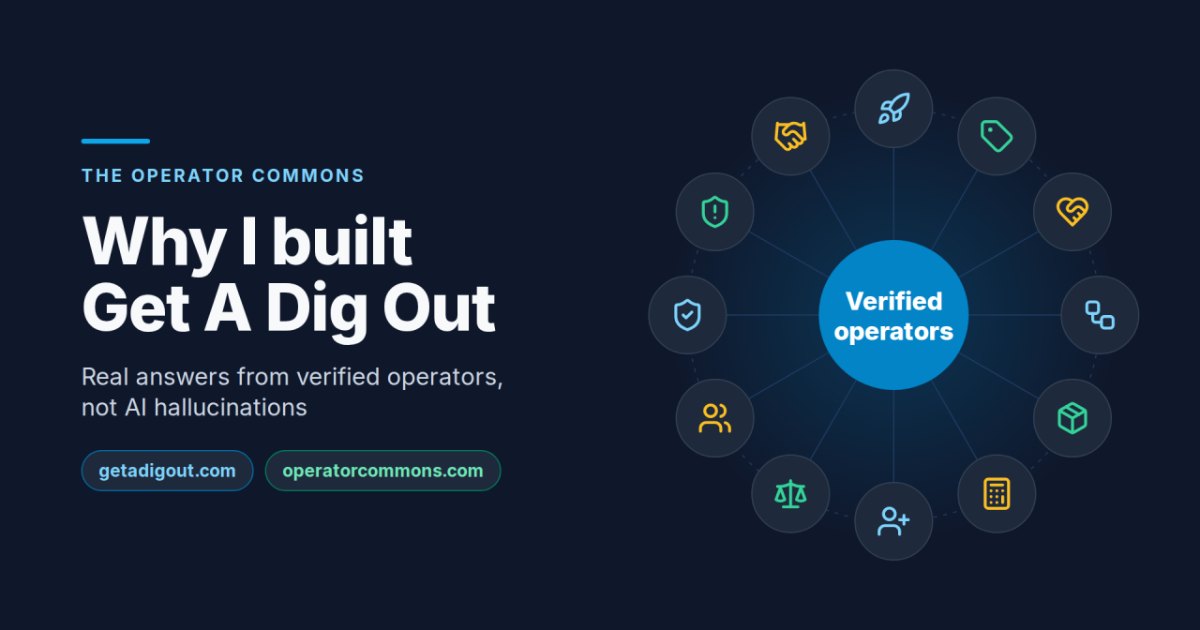
Why I built Getadigout.com (and why it ended up with two names)
Most of us have been there. You’re running a team, something isn’t working, and you know someone, somewhere, has already solved it. You just don’t know who they are.
I’ve spent over 20 years in B2B software sales, leading teams across EMEA and beyond. In that time I’ve hit plenty of problems I’d never seen before: a new pricing model, a channel that wouldn’t take off, a team that wouldn’t keep the CRM up to date. Each time, the answer existed. It was sitting in the head of an operator at another company.
When I knew that person, I’d message them, and ten minutes on the phone would save me weeks. When I didn’t, I was on my own. That gap is why I built Get A Dig Out.
The gap between “Google it” and “hire a consultant”
When you’re stuck on an operational problem today, you have four real options. Each one has a catch.
- Ask AI. It’s fast and it sounds confident. But it has never run a sales team, fixed a churn problem or sat through a board meeting. You get the average of the internet, not the experience of someone who did it.
- Post on a forum. Anyone can answer, and you have no idea who has actually done the thing they’re describing.
- Hire a consultancy. You’ll get good thinking eventually, after a scoping call, a proposal, a retainer and a deck. For a specific problem that often takes longer than the problem does.
- Ask your network. Still the best option, and the one I relied on most. But it only reaches the people you happen to know, and you can only call in so many favours.
The expertise exists. Experienced operators solve these problems every week, and most of them are happy to help when they’re asked properly. What’s missing is a place to ask them, where you know who you’re hearing from, and where they get some credit for helping.
Why it has two names
In Ireland, where I grew up, asking someone to “give us a dig out” means asking for a hand. It’s what you say to a neighbour, a mate or a colleague when you’re stuck. That’s exactly the spirit I wanted: one operator helping another, no fuss.
Then the feedback came in. A strategy review a former illustrious colleague ran on the site was blunt: outside Ireland and the UK, “dig” sounds like digging a hole. A VP in San Francisco, Berlin or Singapore might not get it at first glance. It suggested a more descriptive name, and the obvious one was already on the site as the tagline: The Operator Commons.
So rather than pick one, I kept both:
- getadigout.com is the home of the beta. It’s the name with a story behind it, and it works well with the people I know.
- operatorcommons.com says exactly what it is to someone who has never heard the phrase. It points to the same place.
It’s a small example of how the whole site has been built: put it in front of people, listen, and change it. Getting both domains cost a lot less than guessing wrong.
Who it’s for
There are two sides, and both have a problem worth solving.
Companies that are stuck. Usually scale-ups of 5 to 500 people. Big enough to have real commercial and operational problems, not big enough to throw a consultancy at every one. The founder, COO or head of sales who needs an answer from someone who has done it before, not a theory.
Operators who have been there. Senior people across GTM, RevOps, pricing, customer success, finance, legal, people and more. I see three kinds:
- Leaders in a full-time seat who want to test their thinking against problems outside their own company, and build a reputation that belongs to them rather than their employer.
- Advisers and fractional executives who are tired of cold pitching. Solving a real problem in the open shows what you can do far better than a sales deck.
- People between roles. I’ve been there myself. A CV tells a company what you’ve done; answering their actual problem shows them how you think. It keeps you sharp, and it gets you noticed for the right reasons.
How it works, and what your feedback changed
The idea is simple. A company posts a bottleneck. Operators who have solved it answer with a practical playbook. The company accepts the one that works, and that operator earns reputation.
The details are where most of the work has gone, and a lot of them came from people I trust telling me what was wrong:
- You know who you’re hearing from. Everyone signs in with LinkedIn, and operators are verified domain by domain. A RevOps badge means someone has looked at RevOps experience specifically.
- Nobody has to put their name to a problem. One former colleague told me she wouldn’t share real detail if it was public and could be scraped to train AI. She was right. Bottlenecks are posted anonymously, answers show as “Operator #4F2A”, answers are visible to members only, and the site is closed to AI crawlers.
- Operators choose when to step forward. If your answer is accepted, you decide whether the company sees who you are. Some people want the connection; some just want to help.
- Conversation, not just a single winner. Another colleague pointed out that the right clarifying question often matters more than the first answer. So there are anonymous comments for follow-up questions, and “helpful” votes that count separately from accepted answers.
- Skills at a glance. Someone else suggested icons for each domain, so you can see what an operator knows without reading their profile. They’re on every badge now.
It’s free during the beta, with no fees or commissions. If a great answer turns into a 1:1 conversation or something more, that’s between the two of you. V2 wil allow direct monetisation and bounties to give extra incentive or to compensate for involved work.
Where it goes from here
This is a beta for now, and I’m building it in the open. If any of this sounds familiar, here’s how to get involved:
- Go visit the site at getadigout.com or of course operatorcommons.com, get a feel for it and throw me some feedback!
- If you’re stuck on something, post it at getadigout.com. It’s anonymous and free, and operators verified in that area are alerted as soon as it’s published.
- If you’ve solved problems like these, sign in with LinkedIn, apply for a badge in your domain, and answer one bottleneck. The first 50 verified operators to do that become Founding Operators, with a permanent badge and a say in what gets built next.
- If you know someone who would be good at this, or who is stuck right now, send them the link.
- If you’d like a tour first, book a 15-minute walkthrough with me, or just message me here.
And please keep the feedback coming, eitthr directly, via the site or below in comments, but preferably go and try it out! Two domain names, a members-only design and a set of icons say it’s already shaping the site. The next idea could be yours.
And Yes AI helped me a lot! My Vercel, Supabase, Cursor, github, ad creation and cloudflare skills didn't come from nowhere ;)
Loading comments…