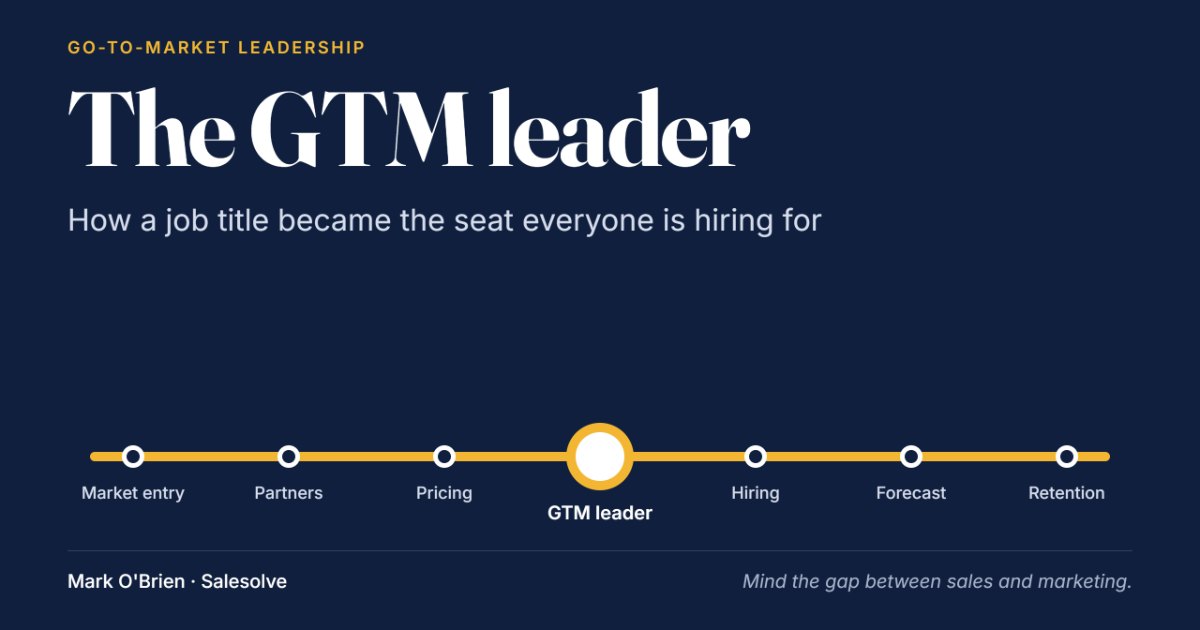
The GTM leader: how a job title became the seat everyone is hiring for
Eighteen months ago, if you asked ten B2B SaaS founders what a “GTM leader” was, you’d have got ten answers and at least one blank look. Today it’s on job specs, board agendas and half the LinkedIn headlines in my feed, mine included. I’ve spent 20 years in sales leadership at Oracle, Emarsys (SAP), ROI Hunter and Luigi’s Box. Here’s what I think has changed, and what hasn’t.
1. The CRO seat got hot and short-lived at the same time
Companies learned that a VP Sales can’t fix a problem that spans sales, marketing, partners, pricing and retention. So they hired CROs, lots of them. Then they changed them quickly.
SBI’s research, published in Harvard Business Review, puts average CRO tenure at about 25 months. Across 150+ B2B companies, 56% saw their growth rate fall in the first full year after a CRO left.
My read is that the title is rarely the problem. The mandate is. If “revenue” is in the title but the person can’t touch pricing, partner strategy or the handover to customer success, you’ve hired a senior salesperson and called them a system designer. ZoomInfo’s 2026 guide says much the same: a GTM leader without authority across functions is “just a strategist with a deck”.
2. AI turned go-to-market into a design problem
ICONIQ’s State of Go-to-Market 2026 surveyed 150+ B2B software GTM leaders in January. It found that companies using AI heavily run materially smaller GTM teams. At $10–25M revenue, high adopters average 20 GTM people against 35 for low adopters. At $25–100M it’s 45 against 65, and at $100–250M it’s 125 against 165.
Leaner teams only work if somebody designs the system they run in: who owns which account, which signals trigger which action, where the handoffs are, and what the forecast is actually built from. That is a leadership job, not a tooling job.
Nobody says it out loud, but the question has shifted from “who do we hire next?” to “what does the machine look like?”
3. A new role showed up to build the machine
The GTM engineer barely existed three years ago. Bloomberry’s analysis of 1,000+ postings found these roles grew about 205% year on year from 2024 to 2025. 38% of postings asked for SQL or Python, and only 1.4% mentioned cold calling. These aren’t glorified SDRs.
I think that’s healthy, and I’d add a caution. A GTM engineer can automate a playbook brilliantly. Someone still has to decide whether it’s the right playbook, for the right market, with the right pricing. Builders need a leader who knows what good looks like in a live deal.
4. Pricing moved into the GTM conversation
ICONIQ’s report is the first big GTM benchmark I’ve seen to cover how companies set quotas and commissions under consumption and outcome-based pricing. About 30% of respondents now use forecasted consumption to set quota.
Usage-based pricing changes who is accountable for revenue after signature, how you compensate reps, and how you forecast. If your GTM leader isn’t involved in pricing, they’re only half in the job.
What this looks like on the ground
In my most recent engagement, a bootstrapped AI company selling into ecommerce, the brief was never “get us more leads”. The real questions were which markets to prioritise, which to approach through partners and which directly, how to build the team, and how to produce a forecast the board could trust.
The answer wasn’t one clever tactic. It was sequencing, hiring, partner strategy, pricing input and a weekly operating rhythm, held together by one person with the authority to make the trade-offs. That is what I think “GTM leader” really means.
I learned the same lesson much earlier at Oracle University, where I set up the first EMEA sales centre in Bucharest and went from zero to 20 reps in 12 months. Later, at Emarsys, I led global sales development through the integration into SAP. The decades and companies differ, but the job doesn’t change: build the system, then coach the people in it.
What I’d tell a founder or CEO today
- Define the mandate before you write the job title. What can this person decide, and what can they not touch?
- Decide whether you need a permanent executive or a fractional one. At a certain stage, 1–3 days a week of senior judgement beats a full-time hire who has to learn the market on your budget.
- Hire builders, but make sure someone senior owns the playbook they’re building.
- Put pricing, partners and retention inside the GTM conversation.
- Judge the role on a forecast you can trust, not on activity.
The GTM leader isn’t a fashionable new title for a sales director. It’s the answer to a real problem: revenue now depends on a system, and systems need an owner.
If you’re a B2B SaaS or AI company working through international growth, a leadership gap or a GTM redesign, I’m always glad to compare notes.

Loading comments…