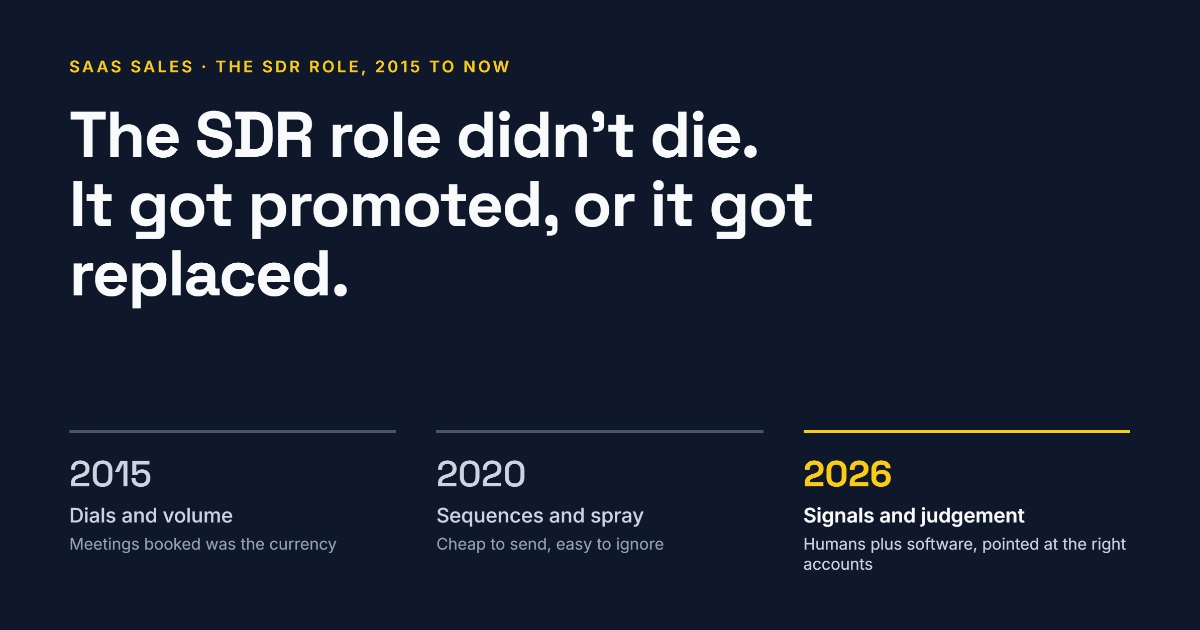
The SDR role didn’t die. It got promoted, or it got replaced.
I started working with SDR teams around 2015, when the job was simple to describe and miserable to do. Make 60 dials a day, send the sequence, book the meeting, hand it over. Nobody asked what happened after the handover. Meetings were the currency, and we paid out in volume.
It worked, for a while. The model came out of the Predictable Revenue era and it was a good answer to a real problem: specialising prospecting freed up closers to close. But a model built on volume carries a hidden assumption, that buyers have no defences. That stopped being true some time ago.
The spray years
At Emarsys, I remember a rep on the team who hit his meeting target for six straight months. Everyone was thrilled until we looked at the pipeline. Roughly two thirds of his meetings were with people who had no budget, no authority, or in one memorable case, no idea why they’d said yes. Politeness had been mistaken for interest. The AE who inherited them spent more time disqualifying than selling.
That’s the flaw in a meetings-booked metric. It rewards the SDR for getting a yes, not for finding a deal.
Then buyers got smarter and inboxes got louder
Somewhere around 2018 to 2020, tooling made it cheap to send a thousand emails and nearly free to personalise the first line. So everyone did. Buyers learned to spot the “I loved your recent post” opener from a mile off. Reply rates fell, and the answer from most teams was to send more, which made it worse.
At ROI Hunter, I watched a very good SDR abandon a templated sequence and write four short, specific emails a day to marketers whose ads she had actually looked at. Her volume was a fraction of the team’s. Her conversion was multiples of theirs. It wasn’t a trick. She’d just done the thinking that the tooling was designed to let her skip.
The 2023 reckoning
When funding tightened, SDR teams were among the first things cut. The logic was blunt: it’s a cost centre with a long payback, and the output is often unqualified. Plenty of companies moved prospecting back to account executives, or to marketing-led motions. Some of those moves were panic, and some were right.
Then AI arrived and promised to do the whole job. The pitch was seductive: an agent that researches, writes, sends and follows up, at a fraction of the cost. Some teams have made it work. Plenty have found out that automating a bad outreach motion just gets you to the spam folder faster, especially with the tightened sender rules from the big mailbox providers.
What the role is becoming
Here’s where I think we’ve landed. The repetitive parts, such as list building, data enrichment and first-draft copy, are increasingly done by software. What’s left is the part that was always the real job:
- Judgement about who to talk to and why now. Buying signals such as a hire, a funding round or a tech change beat any list.
- Research that is visible in the message. If the AI could have written it, the buyer can tell.
- Real conversations. Handling objections live, and knowing when a “not now” is a “never”.
- Accountability past the meeting. Pipeline quality and conversion to closed-won, not calendar invites.
The best SDRs I’ve worked with look less like call-centre staff and more like junior strategists, or increasingly, like operators who run a stack of tools and point it at the right accounts. Some companies are even renaming the role to reflect that.
What I’d tell a sales leader
- Stop measuring activity. If your SDRs are judged on dials and meetings, that is what you will get, and that is what the buyer is already tuning out.
- Hire for curiosity and writing. Tools can be taught in a week. Taste can’t.
- Be honest about where AI helps. Use it to remove drudgery, not to remove the human from the one moment where trust is built.
- And if you’re an SDR reading this: the entry-level job of 2015 is going away. The skills that made the best of us good at it, listening, research and nerve, are worth more than they’ve ever been. Build those, and you won’t be competing with the software. You’ll be the one directing it.

Loading comments…